THE PUPPET MASTER'S SHADOW: COL. SAM AHMEDU AND NIGERIAN BASKETBALL'S ENDLESS CYCLES
Nigerian basketball’s leadership crises are often described as unfortunate accidents of governance. In reality, they reflect a recurring pattern of calculated influence. Across successive administrations, Colonel Sam Ahmedu (Rtd) has operated not as a neutral stabilizer, but as a decisive enabler—consistently positioning himself behind embattled incumbents and invoking constitutional technicalities and FIBA authority to legitimize contested outcomes.
A Critical Examination of Power, Patronage and the Politics Behind the Throne
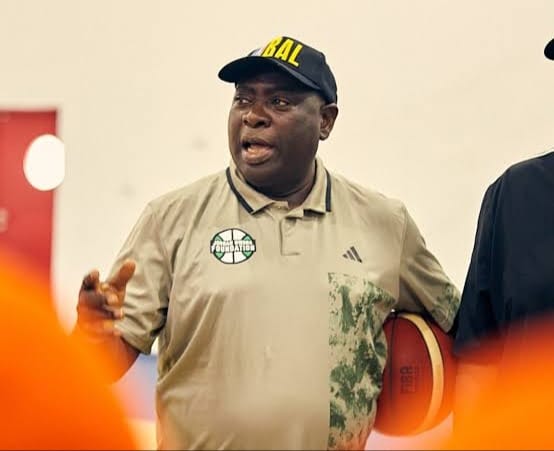
The history of Nigerian basketball administration reads like a Greek tragedy repeating cycles of crisis, contested elections, and constitutional controversies. And if you look closely enough at each act of this drama, one name appears with remarkable consistency in the shadows: Colonel Sam Ahmedu (Rtd).
Not always as the protagonist mind you, but often as the figure moving between factions, the voice justifying parallel elections, the administrator whose FIBA connections seem to validate whatever side of a dispute he chooses.
For stakeholders hoping to understand why Nigerian basketball lurches from one leadership crisis to another, examining Ahmedu's role across multiple administrations reveals uncomfortable patterns that demand scrutiny.
THE ARCHITECTURE OF INFLUENCE
Col. Ahmedu’s credentials are impressive and undeniable: a lawyer, former military officer, founder of Dodan Warriors Basketball Club and since 2023, serving his third term as President of FIBA Africa Zone 3.
He has also coordinated the Nestle Milo Basketball Championship since 1999, a program that has meaningfully advanced grassroots basketball in Nigeria.
These accomplishments are real and have positively shaped the sport, giving him a level of authority and legitimacy few can match.
Yet this very credibility has made his political maneuvering more consequential. Rather than building on his achievements, Ahmedu has repeatedly positioned himself at the center of major NBBF crises, presenting himself as a defender of stability and constitutional order while backing factions that serve his interests.
From protesting the 2013 federation election guidelines to supporting Musa Kida during the 2017 constitutional disputes, his influence has consistently shaped outcomes behind the scenes, with lasting consequences for Nigerian basketball.
THE KIDA ERA: ARCHITECT OR ENABLER?
When Musa Ahmadu-Kida was elected NBBF President in June 2017 amid dual elections in Kano and Abuja, Col. Ahmedu was already a key player not a neutral observer, but serving on Kida’s board as International Representative.
This began an eight-year period marked by crisis, player protests, and administrative dysfunction, with Ahmedu consistently defending Kida’s legitimacy while dismissing rival claims as politically motivated.
During this time, Ahmedu’s dual role as a domestic board member and FIBA Africa Zone 3 President created a clear conflict of interest. He publicly spoke for FIBA to reassure stakeholders about potential sanctions, all while actively serving on Kida’s board, blurring the line between independent oversight and partisan support.
Player discontent grew steadily, culminating in 2021 when the D’Tigress women publicly criticized the administration for unpaid allowances, lack of recognition, and absent leadership.
Throughout these complaints, Ahmedu remained silent on actual failures, focusing instead on defending the board’s constitutional legitimacy and protecting the administration he served.
2022: The BENIN CITY MANEUVER
The 2022 NBBF elections marked the height of Ahmedu’s behind-the-scenes influence, highlighting his role in sustaining crisis rather than resolving it.
When the Federal Ministry of Sports directed that elections be held in Abuja under ministry supervision, the Kida-led board, with Ahmedu as a key member, refused, insisting that Congress had constitutionally approved Benin City as the venue.
This interpretation was legally defensible but politically convenient, allowing an incumbent facing player opposition to maintain control. On January 31, 2022, two elections occurred simultaneously: Kida won unanimously in Benin City with FIBA observers, while Mark Igoche and players held a separate vote in Abuja under ministry oversight.
Ahmedu was in Benin City, reelected to Kida’s board as International Representative, and defended the legitimacy of the Benin election using his FIBA credentials. His involvement gave the contested election an appearance of international approval, reinforcing the incumbent faction while sidelining the Abuja vote.
Players and stakeholders reacted strongly, staging protests and rejecting Kida and his enablers. Representatives like Ejike Ugboaja emphasized that the ministry and board were ignoring the will of the players, highlighting that Ahmedu’s continued support and legitimization of the administration came at the expense of athletes and the integrity of Nigerian basketball.
THE DEVIL'S ADVOCATE POSITION
Col. Sam Ahmedu is portrayed as publicly presenting himself as a guardian of due process citing FIBA rules, constitutional order and resistance to government interference. However, the passage argues that this posture masks a pattern of selectively applying these principles in ways that consistently favor the faction he supports.
The text highlights the 2025-2026 election timeline dispute as an example. When authorities insisted that NBBF elections be held in January 2026 and barred any third-term bids, Ahmedu emphasized that the board’s tenure began on January 31, 2022, seemingly taking a principled stand against any extension of Kida’s leadership.
Yet, the same constitutional rigor was absent when it conflicted with Kida’s interests. Although the board was sworn in on January 31, 2022, it was only formally inaugurated by the Ministry of Sports in October 2022—a gap Ahmedu’s interpretation used to effectively extend Kida’s tenure. The passage concludes that this selective precision reflects calculated political positioning rather than neutral constitutional advocacy.
THE FIBA SHIELD
Ahmedu’s influence is portrayed as rooted in his ability to invoke FIBA authority while advancing domestic factional interests.
As FIBA Africa Zone 3 President since 2019, with a renewed mandate through 2027 he holds genuine continental power which allows his local political positions to be framed as international directives.
During the 2021–2022 election disputes, he warned that ministry intervention could trigger a FIBA ban and accused government officials of violating the constitution.
This effectively cast routine oversight as a threat to Nigeria’s global standing, pressuring stakeholders to align with the faction recognized by FIBA.
The passage argues that this “weaponization” of FIBA authority had real consequences. Players and groups who backed alternative leadership were depicted not as exercising democratic rights, but as endangering Nigeria’s international status, turning external recognition into a tool of domestic political control.
THE COST OF KIDA'S TENURE
If Ahmedu’s influence were merely political maneuvering, it might be dismissed as routine sports politics. However, the passage argues that his role in sustaining Kida’s administration had real and damaging consequences for Nigerian basketball.
On player welfare, D’Tigress athletes reported being owed significant sums by the NBBF, the Ministry of Sports, and from bank donations debts to players who delivered international success. These were not abstract disputes but unpaid obligations that directly affected athletes.
Administratively, the men’s league collapsed for three years due to ongoing chaos, forcing many players out of the system. The 2022 parallel elections further deepened the crisis, creating a legitimacy standoff that ended only when the ministry accepted the Benin City faction, weakening oversight and constitutional order.
Despite these failures, Ahmedu remained on the board, using his FIBA standing to shield the leadership from accountability.
The summary concludes that while grassroots programs like the Milo Championship existed, the federation became increasingly disconnected from players and stakeholders, even as Ahmedu publicly claimed to act in the sport’s best interest.
THE PATTERN ACROSS ADMINISTRATION'S
This pattern did not begin with the current leadership. In 2013, Ahmedu opposed the National Sports Commission’s election rules. In 2017, he aligned against Tijjani Umar. In 2022, he defended the Benin City parallel election.
Across these episodes, the argument is that the constant is not principle but positioning. He is portrayed as consistently backing the side most likely to prevail, while projecting an image of institutional integrity.
This is described as the role of a godfather: never holding the top office, yet always shaping outcomes. Never openly directing events, but present at decisive moments with the authority to legitimize one faction over another.
And when those factions fail through unpaid players, collapsed leagues, or administrative crises—he can distance himself, claiming adherence to procedure, FIBA rules, or constitutional order, even as the sport continues to suffer.
THE WARNING TO STAKEHOLDERS
As Nigerian basketball heads into the 2026 election cycle, stakeholders are urged to reflect on past leadership patterns. While Col. Sam Ahmedu is likely to present his long service, FIBA role, and grassroots contributions as proof of stability, the central concern is not his credentials but a recurring pattern of backing troubled administrations.
The issue is whether his influence has genuinely advanced the sport or merely sustained cycles of crisis under the guise of experience.
Ultimately, the sport needs accountable, transparent leadership focused on domestic development rather than political maneuvering. Nigerian basketball deserves an honest assessment of how powerful figures, including Ahmedu, have used their positions whether to resolve long-standing problems or to perpetuate them. The call is for leadership that serves players and stakeholders first, and finally breaks the cycle of dysfunction.
CONCLUSION: BREAKING THE CYCLE
Col. Sam Ahmedu is described as a capable administrator whose legal expertise, global connections, and achievements like the Milo Championship show real potential to advance Nigerian basketball. However, the passage argues that his long presence across multiple administrations reflects a pattern of political positioning rather than confronting the deep structural problems within the NBBF.
With the 2026 elections approaching, stakeholders are urged to evaluate his role critically rather than reverentially. The author contends that experience and FIBA credentials do not automatically mean neutrality or reform, especially given his perceived alignment with embattled leadership.
The piece ultimately challenges the basketball community to choose between repeating familiar cycles of crisis or deliberately breaking from them. It concludes that Ahmedu’s long-standing influence should be re-examined and that future claims of acting in the sport’s best interest must be met with careful scrutiny.
READ ALSO: the-last-desperate-play-nbbfs-unconstitutional-power-grab-threatens-nigerian-basketball
Sources & References
- This article is based off correspondence from Nigerian basketball stakeholders, regulatory bodies, and federation insiders
Disclaimer
ASIO publishes information for public interest, research, and educational purposes. Allegations reported are not determinations of guilt. All individuals and organizations are presumed innocent until proven otherwise by a competent legal authority.